
‘Re(Born) from Volcanos’ reveals cultural richness around Ring of Fire – Art & Culture
ountains and volcanoes have always held a special place for humans. Across countries and cultures, they have been revered and often have shaped political, social, cultural and mythological narratives.
Indonesia has a fair share of volcanic eruptions, from the world-renowned Krakatoa eruption in the Sunda Stait (1883) followed by Anak Krakatoa.
Many volcanoes are focused in an area known as the Ring of Fire, a ring of volcanoes that runs through the continents and archipelagos that surround the Pacific Ocean, linking distant territories lying between the Abya Yala – the name given by indigenous communities in the Americas – and Asia.
Illuminating knowledge evoked by recurring volcanic cycles of birth, existence, destruction and recovery, volcanoes also bring forward the close links between man, land and the environment, providing a powerful source of information on the relationships between man’s existence and the intricate links to cultural and existential beliefs and realities.
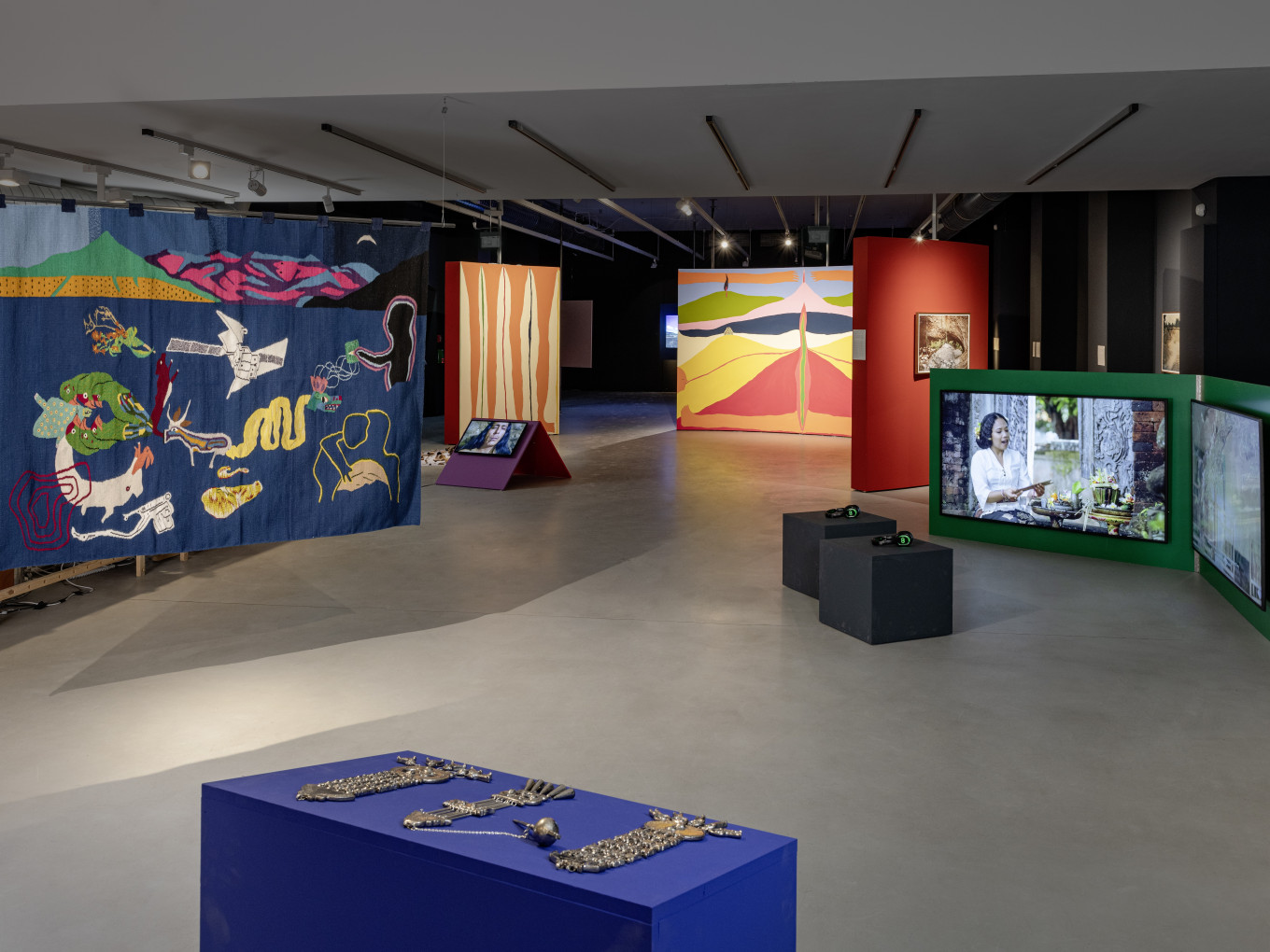
Encompassing works that trace the cultural, political and spiritual practices connecting with the recurrent cycles of birth, existence, destruction and recovery, an exhibition at the ifa Gallery in Stuttgart, Germany, titled “Re(Born) from the Volcanos”, renders a powerful source of knowledge emerging from the largest range of volcanoes that link lands lying between Abya Yala and Asia.

Jewelry from the Mapuche indigenous people is displayed during the “Re(Born) from Volcanos“ exhibition at ifa Gallery in Stuttgart, Germany. The exhibition runs until Feb. 23. The Mapuche are a group of indigenous inhabitants of south-central Chile and southwestern Argentina, including parts of Patagonia. (Courtesy of ifa/-)
The fascinating exhibition is therefore an important point in time that captures the emotion and imagination of 20 artists from places around what is called the Ring of Fire.


